ANZAC Sunrise.
Already the sun was rising quickly from the east. Its splayed light beams punching through gaps in the thunder clouds. It was promising to be another perfect day in Queensland paradise.

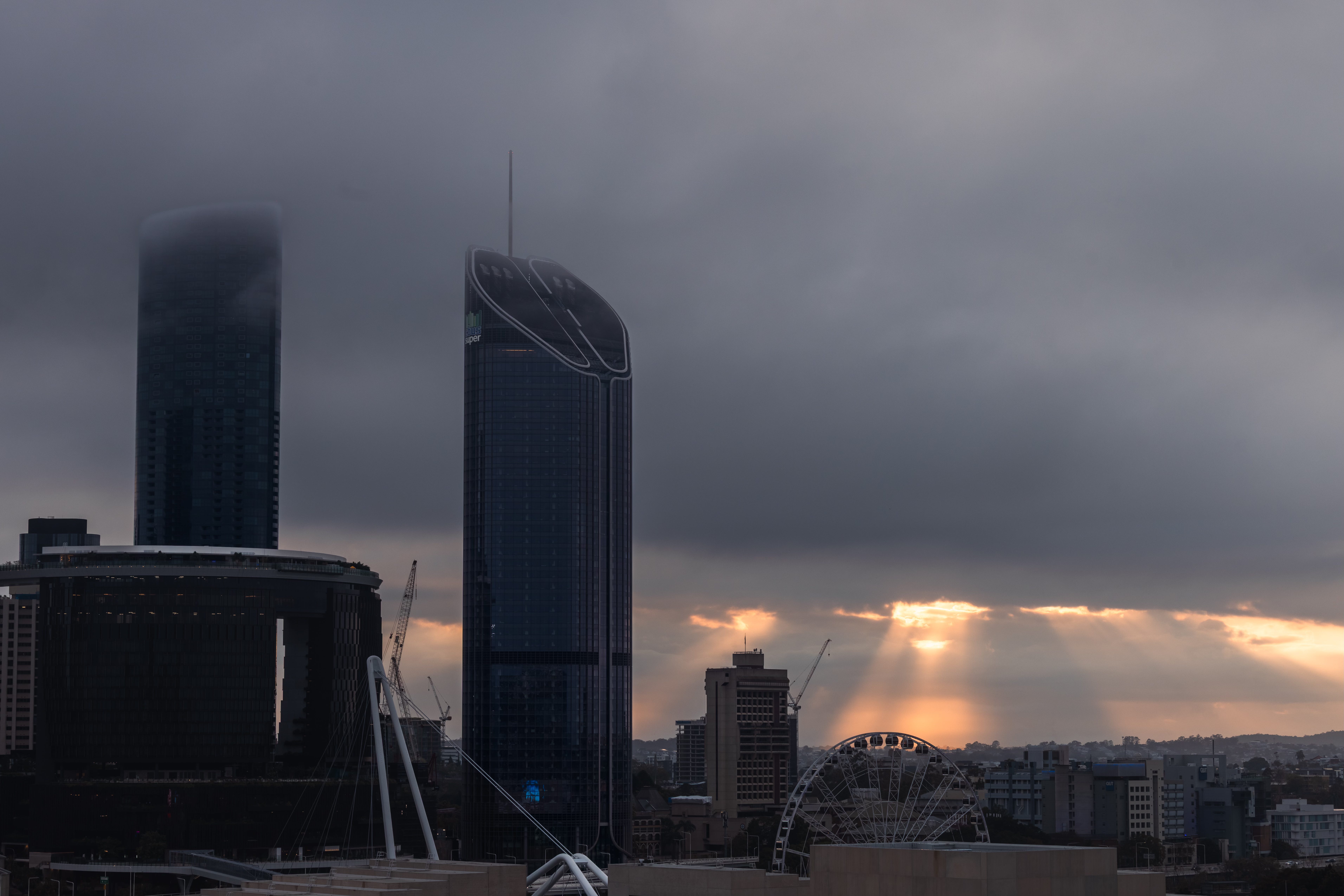
Sunrise, Brisbane. Photography: James Wilkes 2025
I sipped my English tea from a forgettable mug on our Brisbane hotel balcony. I was perched on the 15th floor and I had deliberately jumped out of bed early to watch the sunrise. It was 5.00 o’clock, tropically balmy, and pleasantly warm. There was no wind, the streets were quiet, and the cacophony of last night’s revelry had ceased. There would be some sore heads this morning. Argh, the memories.
Already the sun was rising quickly from the east. Its splayed light beams punching through gaps in the thunder clouds. It was promising to be another perfect day in Queensland paradise. The state’s famed and clichéd tourism slogan was proving to be accurate, it really was perfect one day, beautiful the next. As the sun made its presence felt the tortured cirrus clouds, spread in an intermittent canvas across the sky, slowly retreated from last night’s spectacular electrical performance. If I was religious, I would have said god was angry last night. This morning is different, the dancing light ray scene in front of me looks like god is waving a torch around.
The light rays were being showcased by the city’s skyline, reminding me of the Rising Sun badge proudly worn on the slouch hats of Australian soldiers. The distinctive silhouette of the Rising Sun badge, worn on the upturned brim of the slouch hat, has long been associated with the spirit of ANZAC and the enduring tradition of the Australian soldier. The origins of the Rising Sun dates back to 1902. A unifying ‘brand’ was needed to unite Australian contingents after Federation, for service in the Boer War, South Africa.
“Australia became a nation on 1 January 1901, after the British Parliament passed legislation enabling the six Australian colonies to collectively govern in their own right as the Commonwealth of Australia.”
That’s a bloody long way back now but in my own way I’m connected to the history through my own heritage and personal ‘Dreamtime’. And isn’t that what personal reflection is? Thinking my way back through history, pondering philosophical constructs, while history bounces off the mirrors of time and generational momentum.
Like the first Australians, my ancestral spirit also winds back through time, shaping my identity and connecting me to my country, ecology, and life. It’s a storyline that fuses a continuous link between my past, present, and future, and provides me with a spiritual connection to my homeland, Australia. As I struggle to make sense of it all, I have taken to sharing my experiences through stories and photography, which is cathartically rewarding. It’s my way of offering up some sort of rationale for being here beyond pure chance, which of course, is the sobering reality for all life. And how else do I stand out from the other 8 billion humans surfing through space at 1600 kph on the same rock as me?
It’s bizarre if you think about it. How lucky are humans? We evolved from single-celled organisms as part of a natural phenomenon over millions and millions of years. Winning mother nature’s bingo night we diverted from apes around 6 - 8 million years ago, and here we are, doing our very best to mess it all up. Mmmm, another story for another day, and as per usual, I digress.
Back to it. Reflecting backwards, 123 years have passed. Much has changed. ANZACS that went to the Boer War and then to Gallipoli in World War One wouldn’t recognise the world today. The world they knew has been altered beyond recognition. Beyond values, beyond any moral code they could assimilate with. The physical landscape they knew has been reshaped, extracted, exploited. It would be unrecognisable to a 19 year old ANZAC.
Agriculture at scale, mining of minerals to resource exhaustion, fishing at depth to depletion, and deforesting the wild. Each wanton, human driven extraction has all played a role in making our world so much less than it once was. And so much less than it could be. Human-influenced change has been so significant, scientists have created a new name for them in an effort to somehow capture their extraordinary impact. That name is the Anthropocene.
“The word Anthropocene comes from the Greek terms for human (’anthropo’) and new (’cene’), but its definition is controversial. It was coined in the 1980s, then popularised in 2000 by atmospheric chemist Paul J Crutzen and diatom researcher Eugene F Stoermer. The duo suggested that we are living in a new geological epoch.”
The Anthropocene’s renaming / origin story stems from the 1950s, and is anchored by the “Great Acceleration” of human impacts, especially the global fallout of plutonium from nuclear tests. However, debates continue, with other proposed start dates ranging from the Industrial Revolution (late 1700s) to earlier human impacts. In terms of time, especially geological time, a few hundred years here and there makes little to no difference in the face of the ecocide being served up as an existential entrée by humans.
Emeritus professor (University of British Columbia), human ecologist and ecological economist William Rees, goes straight to the heart of the problem stating, “The proof is irrefutable: humans have colonized every continent and sizable island on the planet—no other vertebrate species’ natural geographic range comes close to that of H. sapiens; humans have an embarrassing record of over-exploiting—often to the point of extinction—other species that we consider edible or that we can ‘harvest’ for economically valuable body parts from soft warm fur to hard cold ivory; industrial humans have burned through prodigious quantities of fossil fuels (we are close to peak petroleum production with no signs of backing off as the green new deal implodes) and the world is running up against supply bottlenecks of crucial metals/minerals such as copper and rare earths. In short, humans are scraping the sides and bottom of our earthly barrel. In the process we have become the dominant geological force changing the face of the planet and are extinguishing much non-human life.”
As Homo sapiens, we were fortunate to evolve a BIG brain. Unfortunately, its game-changing intellectual power and potential has not been leveraged to build stable, sustainable, and egalitarian societies. The sort the ANZACS gave their lives to defend, so here we all are living our hopes and dreams in a world openly displaying its death throes. From polar bears to tigers, to forests and oceans and from sea to shining sea the planetary boundaries are being breached.
Once protective of humans, they are now reaching tipping points that nullify those protections. Alarmingly, tipping points are aptly named, and just like a see-saw, if there’s too much weight on one end there is no longer any balance. Restoring balance is all about understanding leverage points, and unfortunately too few understand them.
Donella Meadows taught us that, “Folks who do systems analysis have a great belief in “leverage points.” These are places within a complex system (a corporation, an economy, a living body, a city, an ecosystem) where a small shift in one thing can produce big changes in everything.” So, want to understand why the ice is melting faster than expected you need to understand the leverage points. For example, global warming, which leads to carbon, which leads to the burning of fossil fuels and so on. See what I mean? You can read and learn more here: Leverage Points: Places to Intervene in a System - The Donella Meadows Project.
Ok, so it’s coming up to Christmas in 2025 and aren’t I a bundle of joy. Seriously though, let’s be honest with one another. There is blood in the water, and whilst few humans are equipped with ampullae of Lorenzini to detect it, there are some outliers who can. These are the scientists, climatologists, environmentalists, ecologists, systems thinkers, and activists that are doing everything they can to signal a five-alarm fire, and make no mistake, it is nothing less than a five-alarm fire.
The problem is, short-term thinking politicians are immune to hard evidence when it intersects with their political ambitions and aspirations. Their see-no-evil, hear-no-evil approach creates an imaginary silence, which enables the cult of ‘the resources infinites’ - my name for ‘extractionists’ - room to manoeuvre. Capitalism lives and breathes in this void , writhing and squirming in unbridled lust for more, more growth, more profit, more of everything. This sub-species of humanity is insatiable and it seems insurmountable.
Politicians with such mindsets - there are many - inadvertently and deliberately amplify, and accelerate, a planetary wide crisis. In 2025, it has become an existential crisis. And many, driven by ambition and lust for power cannot or will not see it. Self-interest and narcissistic ‘gold-fever’ reign supreme. According to The Pollution Sustainability Directory, “Political Myopia, in its most basic sense, is the inclination in politics to prioritize immediate benefits over long-term considerations.”
And that’s a very significant problem for civilisation to say the least. Dr Luke Kemp brings the receipts to prove it in his new blockbuster ‘Goliath’s Curse’. In his dystopian tome, Luke suggests, “We can’t put a date on Doomsday, but by looking at the 5,000 years of [civilisation], we can understand the trajectories we face today – and self-termination is most likely.” Capitalism has morphed into a hydra and like its origin story we are yet to discover our equivalent of Hercules, who is capable of killing it off.
“Perhaps the best (and most widely misquoted) reflection of the meaning of Anzac is to be found in Charles Bean’s Anzac to Amiens. In describing the evacuation of the Anzac Cove area, Bean wrote:
“By dawn on December 20th Anzac had faded into a dim blue line lost amid other hills on the horizon as the ships took their human freight to Imbros, Lemnos and Egypt. But Anzac stood, and still stands, for reckless valour in a good cause, for enterprise, resourcefulness, fidelity, comradeship, and endurance that will never own defeat.”
Perhaps the restoration of a decent world for all requires reckless valour in a good cause. And fidelity, comradeship, and endurance, we’ll need those too. And last but never least, we should absolutely commit to never owning defeat.
My grandfather emigrated from England to Western Australia in the early 1900s and received a parcel of land in Beverley (apologies to the first Australians) where he prepared to enjoy a new life as a farmer. Meanwhile, far away in Sarajevo, a young Serbian infused with revolutionary zeal and youthful belief, plucked up the courage to fire a bullet into a Duke. And shock, horror, World War 1, millions dead, course of history changed.
Sipping the last of my tea I looked at the sun rising and wondered what my grandfather would think of the world today. What would he say? What would he do? I think his answer would be to just bloody get on with it, make a difference or try too. He would say if you believe in something enough, and you believe you’re right, and you want to do something about it, then give it everything you’ve got. Do your best.
And that will hopefully define my endeavours and writing and photography from this point, which is aimed at documenting planet, people, and places. My promise to you the reader is, I will write and photograph with reckless valour in a good cause.
And on that note, a very Merry Christmas to you all. See you in 2026.
Ends.
Meri Kihirimete, James!
Well told. Yes, big brains but not big enough to tackle the rapacious ego attached to it. I love this world. To me the Pacific Ocean is friend so dear, it’s family. This paragraph tells me you may see the world similarly:
Agriculture at scale, mining of minerals to resource exhaustion, fishing at depth to depletion, and deforesting the wild. Each wanton, human driven extraction has all played a role in making our world so much less than it once was. And so much less than it could be. Human-influenced change has been so significant, scientists have created a new name for them in an effort to somehow capture their extraordinary impact. That name is the Anthropocene.”